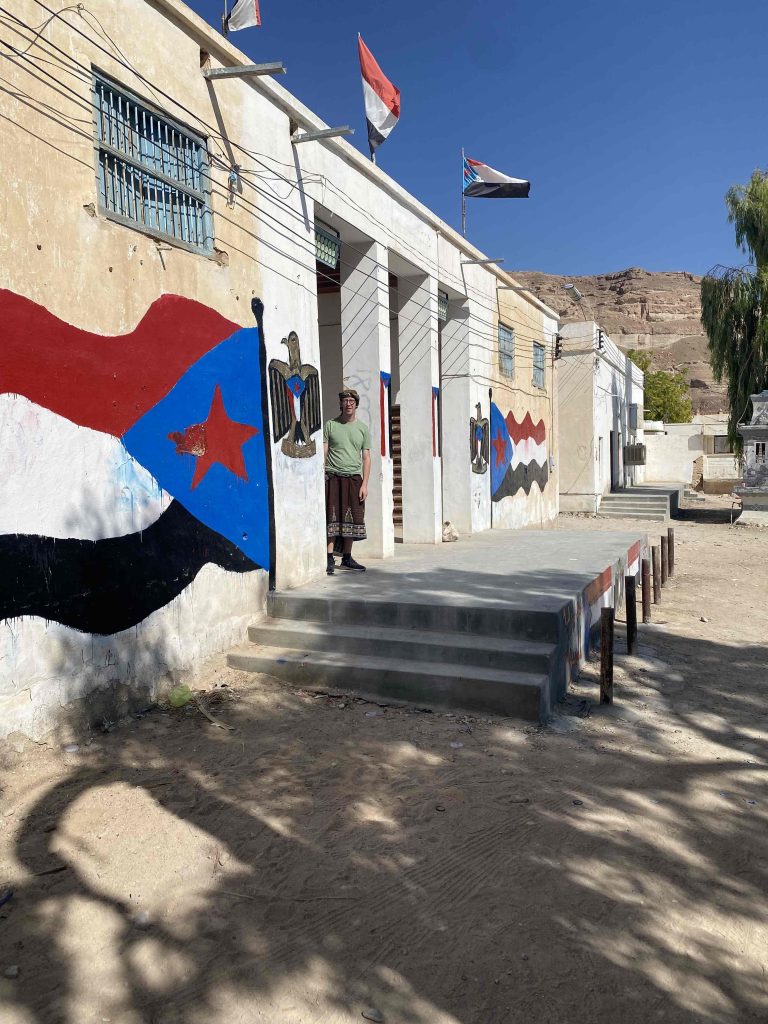
The flag of South Yemen is more than a piece of cloth — it is a compressed political manifesto, a historical statement, and a visual break from the norms of the Arab world.
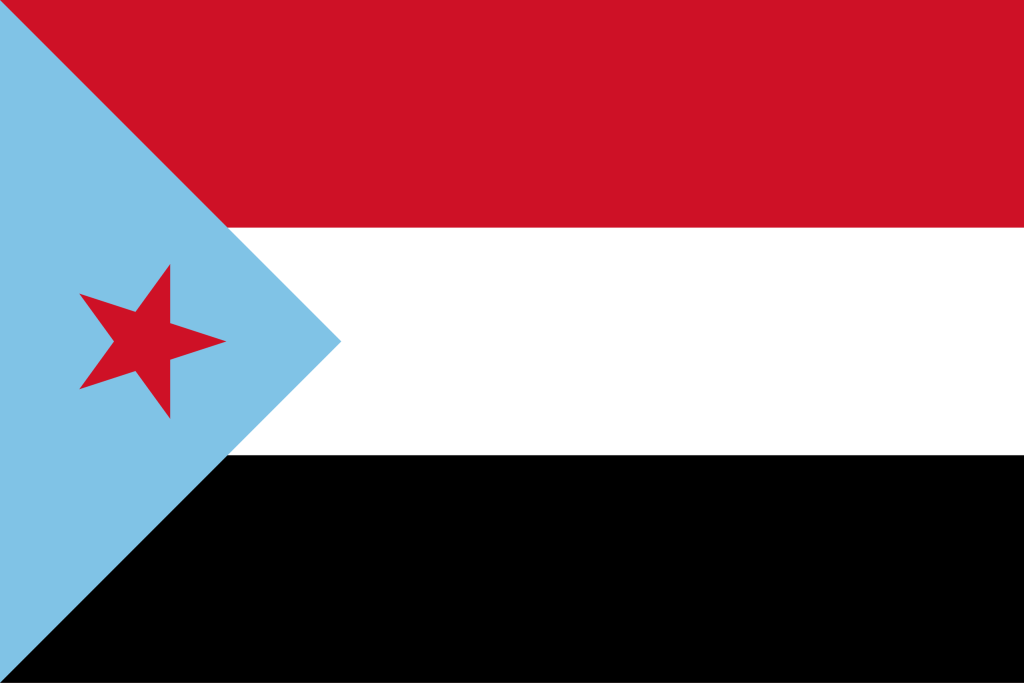
Adopted in 1967 after independence from British rule, the flag consisted of three horizontal stripes: red on top, white in the middle, and black at the bottom. These colors echoed the broader Arab revolutionary tradition — red for struggle and sacrifice, white for hope and a new future, black for the darkness of colonial domination. At first glance, it could have been mistaken for many other flags of newly independent states. But South Yemen added something distinctly different.
On the left side of the flag sat a blue triangle pointing inward, and within it, a red star. This was the defining feature. The star made the flag unmistakably socialist. South Yemen, officially known as the People’s Democratic Republic of Yemen, was the only explicitly Marxist state in the Arab world. While other Arab nations flirted with socialism or revolutionary rhetoric, South Yemen embraced it fully — and the flag proudly reflected that ideological choice.
The blue triangle is often interpreted as a symbol of the sea, fitting for a country centered around Aden, one of the most strategically important ports in the Indian Ocean. Aden was not just a city; it was a gateway between Africa, the Middle East, and Asia — a crossroads that shaped South Yemen’s identity.
This flag flew during a turbulent and ambitious era. South Yemen pursued land reform, expanded women’s rights, nationalized industries, and aligned itself with the Soviet Union and other socialist states. The flag became a symbol of that radical experiment: a small country trying to reinvent itself in a rapidly changing Cold War world.
In 1990, North and South Yemen unified into a single Republic of Yemen. With unification, the socialist state — and its flag — disappeared. The new national flag kept the red, white, and black stripes, but removed the blue triangle and the red star.
Today, the Flag of South Yemen survives mostly in history books, archives, and in the memory of those who lived through that period. For some, it remains a nostalgic symbol of a different political vision; for others, a reminder of a divided past. Either way, it stands as one of the most distinctive and ideologically charged flags ever to fly over the Arabian Peninsula.