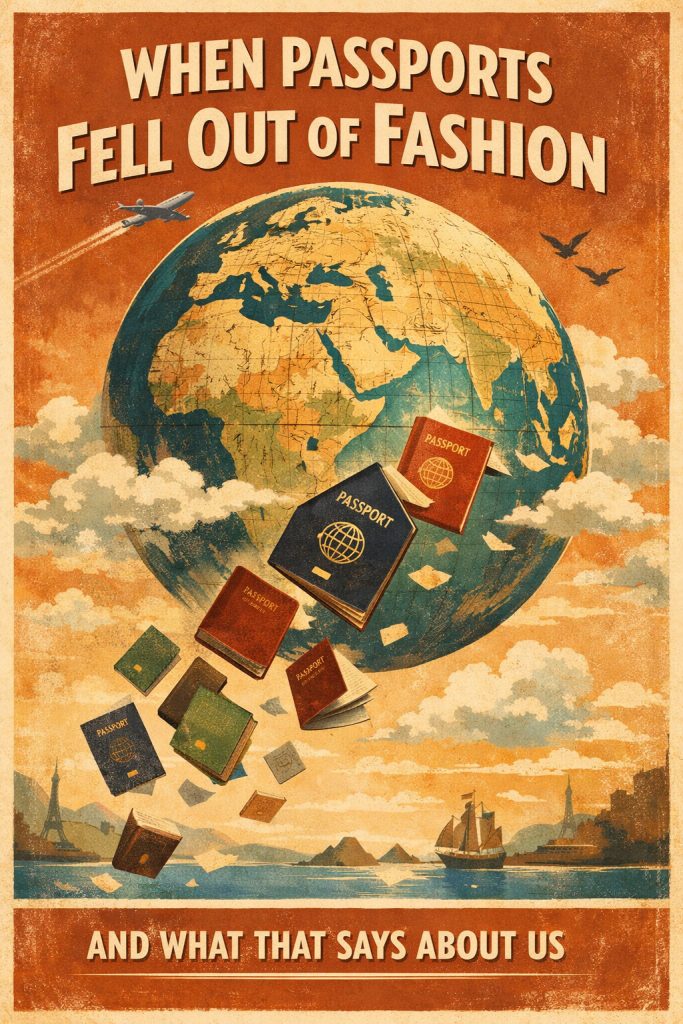
It is easy to assume that passports have always been as inevitable as borders, stamps, and immigration queues. Yet in 1860, across much of Europe, passports had largely fallen out of use.
For several decades in the mid-19th century, crossing borders was, for many travelers, surprisingly frictionless. The great powers of Europe — weary of the bureaucracy of the post-Napoleonic era and buoyed by expanding rail networks — gradually relaxed internal passport controls. You could travel from Paris to Berlin or from Brussels to Vienna with little more than a train ticket and a sense of purpose.
The passport, once a tool of absolutist states, seemed outdated — a relic of a slower, more suspicious age.
This was not because borders disappeared. Empires and nation-states were very much alive. Rather, there was a shared belief that mobility, commerce, and cultural exchange were best served by fewer papers and fewer checkpoints. The world felt, for a brief moment, more connected than constrained.
Of course, this openness did not last.
By the late 19th and early 20th centuries, passports returned with force — driven by rising nationalism, bureaucratic states, and later, the trauma of world wars. What had once seemed unnecessary became indispensable. The free-moving traveler of 1860 would be unrecognizable to us today, fumbling through biometric gates and visa applications.
Looking back at 1860 is not nostalgia for a simpler past — it was hardly simple, and mobility was still a privilege largely reserved for the wealthy. But it is a reminder that our current system is not inevitable. Borders, documents, and surveillance are choices shaped by politics, fear, and power.
Every time you hand over your passport at an airport, it is worth remembering: there was a time when that little booklet was considered obsolete.
And perhaps, someday, it might be again.
Maarten’s Note
Sometimes I catch myself imagining what it would be like to step back into 1860 — to board a train, cross Europe, and simply… move, without passports, visas, or biometric gates. There is something wonderfully liberating about that thought.
As someone who has stood in endless immigration lines, collected stamps like souvenirs, and worried about visas that determine where I can or cannot go, that brief passport-less era feels almost utopian. Not because the 19th century was better — it wasn’t — but because it reminds me that our current system is not the only way the world can work.
I know we can’t literally return to 1860. But I can’t help wishing for a bit of its spirit: a world where movement is assumed, not interrogated. Where curiosity travels faster than paperwork. Where the default is openness rather than suspicion.
And if that once existed, even briefly, then maybe something like it could exist again.
Leave a Reply