Singapore is often ranked among the world’s most efficient, clean, and prosperous destinations. From the futuristic skyline of Marina Bay to its seamless transport system, the city-state feels almost utopian.
But beneath this polished surface lies a far more complex story.
This is not the Singapore of rooftop bars and luxury malls. This is the story of colonial exploitation, wartime brutality, political crackdowns, and the difficult choices that shaped modern Singapore.
🇸🇬 Quick Overview
- Official Name: Republic of Singapore
- Capital: Singapore
- Population: ~6 million
- Region: Southeast Asia
- Colonial Past: British (1819–1942, 1945–1963)
- Independence: 1965
⚓ Colonial Singapore: Wealth Built on Inequality
Modern Singapore was founded in 1819 by Stamford Raffles as a trading post for the British East India Company.
Its strategic location turned it into one of the busiest ports in Asia—but this success came at a cost.
The darker side of colonial prosperity:
- Exploitative labor systems relying on Chinese coolies and Indian workers
- Widespread poverty in overcrowded ethnic enclaves
- Government-backed opium trade used as a major source of revenue
Colonial Singapore was deeply unequal—segregated along racial and economic lines, with wealth concentrated in European hands.
🪖 The Japanese Occupation: Terror and Survival
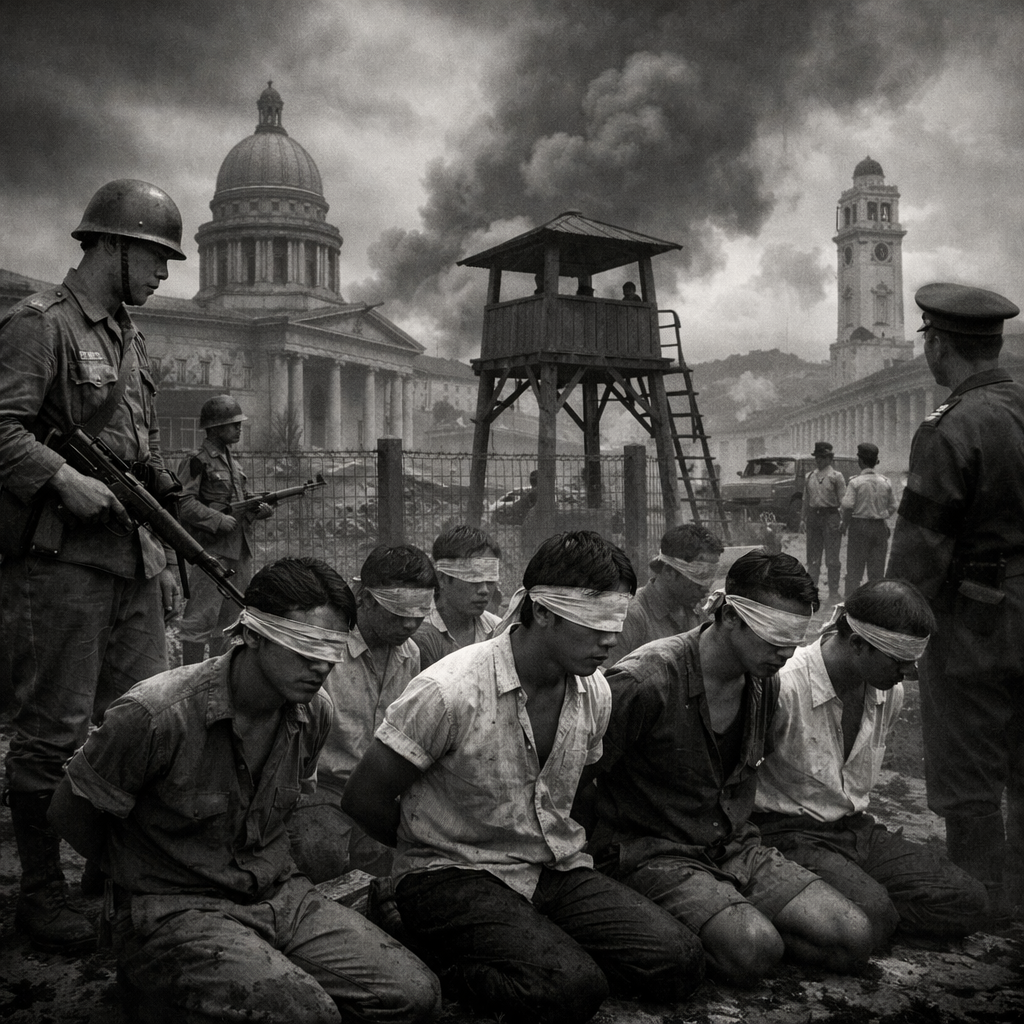
During World War II, Singapore fell to Japanese forces in February 1942—a shocking defeat for the British Empire.
What followed was one of the darkest periods in the island’s history.
Key events:
- The Sook Ching Massacre, where tens of thousands of ethnic Chinese were executed
- Mass imprisonment, torture, and forced labor
- Severe food shortages and economic collapse
Daily life became a struggle for survival. Fear, suspicion, and violence defined the occupation years.
🔥 Riots, Revolution, and an Uncertain Future
The end of the war did not bring stability.
The 1950s and early 1960s were marked by:
- Anti-colonial movements and communist influence
- Labor strikes and student protests
- Violent racial riots between Chinese and Malay communities
Singapore briefly joined Malaysia in 1963—but tensions quickly escalated.
In 1965, Singapore was expelled from the federation and became an independent nation—an uncertain beginning for a small, resource-poor island.
🏗️ Nation-Building at a Cost
Under Lee Kuan Yew, Singapore underwent one of the fastest transformations in modern history.
The strategy:
- Rapid industrialization
- Strict social policies
- Massive public housing programs
But progress came with trade-offs.
Controversial realities:
- Forced evictions during urban redevelopment
- Detention without trial under the Internal Security Act
- Suppression of political opposition
The government prioritized stability and economic survival—often over individual freedoms.
🚫 A Controlled Society: Discipline Over Dissent
Modern Singapore is known for its strict laws—and they didn’t appear overnight.
They are the result of decades of governance focused on order and control.
Key characteristics:
- Tight media regulation and censorship
- Harsh penalties, including caning and capital punishment
- Limited space for political opposition
Supporters argue this created one of the safest and most efficient societies in the world. Critics argue it came at the cost of civil liberties.
🧭 QuixoticGuide Note
Singapore is a paradox.
It is a place where:
- Economic success coexists with political control
- Safety exists alongside strict regulation
- A painful past is often overshadowed by a polished present
Understanding Singapore means looking beyond the skyline—into the difficult, sometimes uncomfortable history that made it what it is today.
✈️ Why This History Matters for Travelers
Most visitors experience Singapore as a stopover destination—efficient, clean, and easy.
But if you look closer, you’ll find layers of history beneath the surface:
- Memorials to wartime atrocities
- Neighborhoods shaped by colonial segregation
- A society still influenced by its turbulent past
Traveling deeper means understanding not just where you are—but how it became what it is.
Leave a Reply