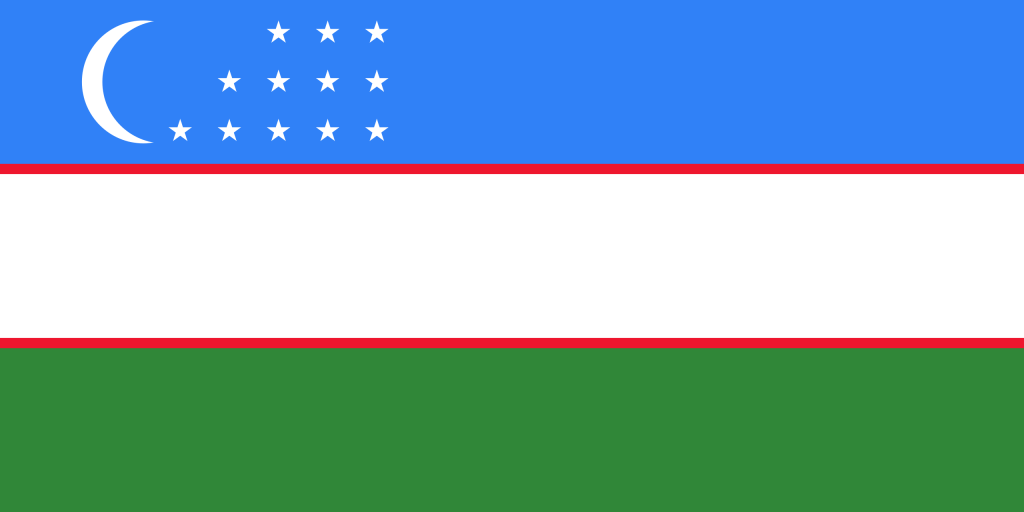
The flag of Uzbekistan is one of Central Asia’s most elegant national flags: a combination of blue, white, and green separated by thin red stripes, alongside a crescent moon and twelve stars.
Adopted on November 18, 1991, shortly after the collapse of the Soviet Union, the flag symbolized the birth of an independent Uzbek state after decades within the USSR.
Its design blends Islamic symbolism, Turkic heritage, Soviet-era history, and the geography of Central Asia into a remarkably balanced composition.
The Meaning Behind the Colors
Blue
Represents the sky, water, and Turkic cultural heritage.
Blue has historically held deep significance across Central Asia, particularly in Turkic civilizations and the architecture of cities like Samarkand and Bukhara, famous for their turquoise domes and mosaics.
White
Symbolizes peace, purity, and a sincere path forward for the new republic.
In Uzbekistan, white is often associated with honesty and good intentions.
Green
Represents nature, fertility, and renewal.
It also carries connections to Islamic tradition, reflecting the cultural and religious history of the region.
Red Stripes
The thin red lines symbolize vitality and the life force connecting the nation together.
The Crescent and the Twelve Stars
The white crescent moon in the upper left corner symbolizes:
- independence,
- spiritual heritage,
- and the emergence of a new nation.
The twelve white stars have multiple interpretations. They are often said to represent:
- the twelve months of the year,
- perfection and completeness,
- or the historical traditions of the Uzbek people.
The arrangement creates a clean and modern visual identity while still drawing from Islamic and regional symbolism.
A Post-Soviet Identity
Uzbekistan’s flag emerged during one of the largest geopolitical shifts of the 20th century: the dissolution of the Soviet Union.
Like other newly independent Central Asian republics, Uzbekistan faced the challenge of creating a national identity distinct from Moscow while reconnecting with older historical traditions.
The flag reflects this balancing act:
- modern yet historical,
- secular yet culturally Islamic,
- national yet regionally Central Asian.
The Colors of Central Asia
The blue tones of the flag feel especially connected to Uzbekistan’s architecture and geography.
Cities such as:
- Samarkand,
- Bukhara,
- and Khiva
are famous for their blue-tiled mosques, madrasas, and mausoleums — reminders of the Silk Road civilizations that once linked China, Persia, and the Mediterranean.
In many ways, the flag visually echoes those colors.
QuixoticGuide Note
Uzbekistan’s flag feels calm and balanced. Unlike some post-Soviet states that adopted aggressive nationalist imagery, Uzbekistan chose a design that emphasizes continuity, harmony, and cultural depth.
The result is a flag that reflects both the legacy of ancient Silk Road cities and the optimism of a young independent republic finding its place between East and West.