The flag of Ethiopia is one of Africa’s most historically influential national flags. Its green, yellow, and red tricolor inspired dozens of liberation movements and eventually became the foundation of the Pan-African color tradition seen across the continent today.
At the center of the modern flag appears a blue circle with a golden star — a symbol added in the 1990s to represent unity and equality among Ethiopia’s many peoples.
The current version of the flag was officially adopted on October 31, 1996, though the tricolor itself dates back far earlier.
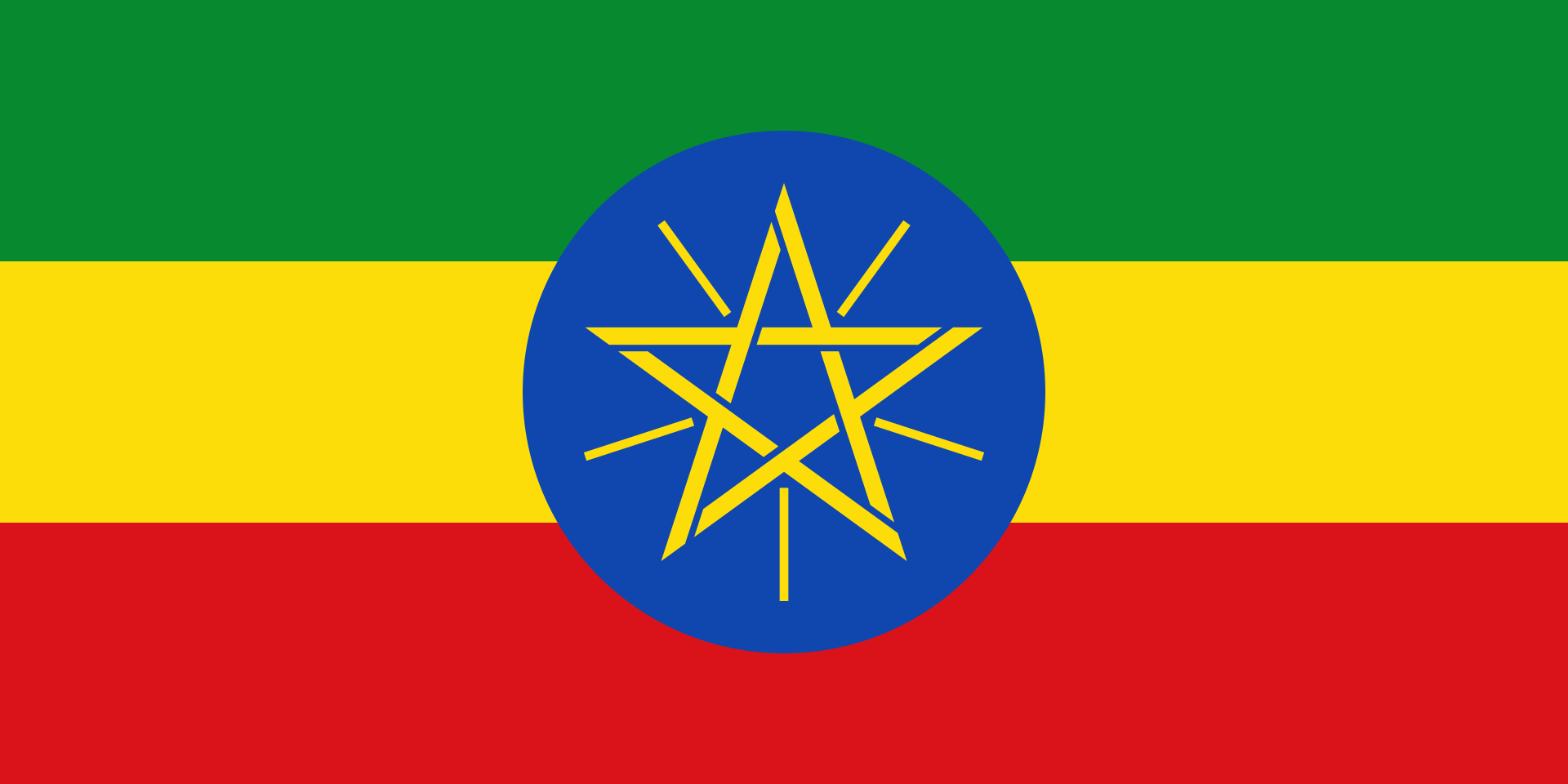
The Meaning Behind the Colors
Green
Represents the land, fertility, and hope for the future.
Yellow
Symbolizes peace, harmony, and coexistence between Ethiopia’s diverse ethnic and cultural groups.
Red
Honors sacrifice and the defense of the nation throughout its long history.
Together, these colors became globally associated with African independence movements during the 20th century.
The Blue Emblem and Golden Star
At the center of the flag is a blue disk containing a golden pentagram.
The emblem symbolizes:
- unity,
- equality among ethnic groups,
- and the interconnected future of the country.
The blue background represents peace, while the rays extending from the star symbolize prosperity and shared progress.
A Flag Older Than Colonial Africa
Ethiopia occupies a unique place in African history.
Unlike most African countries, Ethiopia largely avoided long-term European colonization. Apart from the Italian occupation between 1936 and 1941, the country maintained its sovereignty throughout the colonial era.
This gave the Ethiopian flag extraordinary symbolic power across Africa and the African diaspora.
For many anti-colonial movements, Ethiopia represented:
- independence,
- resistance,
- and African continuity.
The Origins of Pan-African Colors
The Ethiopian tricolor inspired countless African national flags after decolonization.
Countries including:
- Ghana,
- Senegal,
- Cameroon,
- Mali,
- Guinea,
- and many others
adopted variations of green, yellow, and red to symbolize African unity and liberation.
Because of this, Ethiopia’s flag became more than a national symbol — it evolved into a continental one.
Rastafari and Global Symbolism
The Ethiopian flag also holds deep significance within the Rastafari movement, which emerged in Jamaica during the 1930s.
Haile Selassie, Ethiopia’s emperor from 1930 to 1974, became a central spiritual figure within Rastafarian beliefs.
As a result, the Ethiopian flag gained cultural influence far beyond Africa, appearing in:
- reggae music,
- Rastafarian imagery,
- anti-colonial movements,
- and Pan-African activism worldwide.
A Country of Deep Historical Layers
Ethiopia is home to one of the world’s oldest civilizations and possesses a history stretching back thousands of years.
From:
- the rock-hewn churches of Lalibela,
- to the castles of Gondar,
- to the highlands surrounding Addis Ababa,
- and the ancient kingdom of Aksum,
the country’s landscapes and cultures carry an extraordinary historical depth.
The flag reflects that long continuity — balancing ancient identity with modern statehood.
QuixoticGuide Note
Ethiopia’s flag may be one of the few national flags whose influence extends far beyond its own borders. Across Africa and the diaspora, its colors became symbols of independence, dignity, and resistance against colonial rule.
In many ways, the Ethiopian flag does not just represent a country — it represents an idea: that African sovereignty could survive, endure, and inspire others.