There are cities that welcome you loudly — and cities that barely notice you’ve arrived.
Constanța belongs to the second category.
You don’t enter it so much as drift into it. The train from Bucharest slows, apartment blocks appear, and then suddenly the air changes. Not salty in a Mediterranean way. Softer. The Black Sea doesn’t crash — it breathes. And along that breathing shoreline stands a city that has never fully decided whether it is an ending or a beginning.
A Port Older Than Most Countries
Constanța was founded as Tomis by Greek traders more than 2,500 years ago.
That fact sounds impressive — until you walk around and realize the past isn’t curated here. It leaks.
Roman mosaics sit below street level like a basement memory.
An Ottoman mosque stands a few streets from Orthodox churches.
Communist boulevards lead directly into Belle-Époque facades.
History here isn’t layered neatly.
It overlaps.
The poet Ovid was exiled here by the Roman emperor Augustus in 8 AD — essentially sent to the edge of the known world. He spent his last years writing letters begging to leave. Ironically, two millennia later, people voluntarily come to the same shore for summer holidays.
Constanța might be the only place in Europe that was once punishment — and later became leisure.
The Casino That Watches the Sea
Nothing explains the city better than the Constanța Casino.
It doesn’t function anymore.
It doesn’t need to.
Standing at the end of the promenade, the Art-Nouveau building faces the horizon with theatrical stubbornness, as if still expecting aristocrats in evening wear to arrive by steamship. The sea wind has aged it more than time has. You don’t look at it — you look with it.
Some buildings decorate a coastline.
This one narrates it.
Around sunset, locals walk past without stopping. Visitors stop without understanding why.
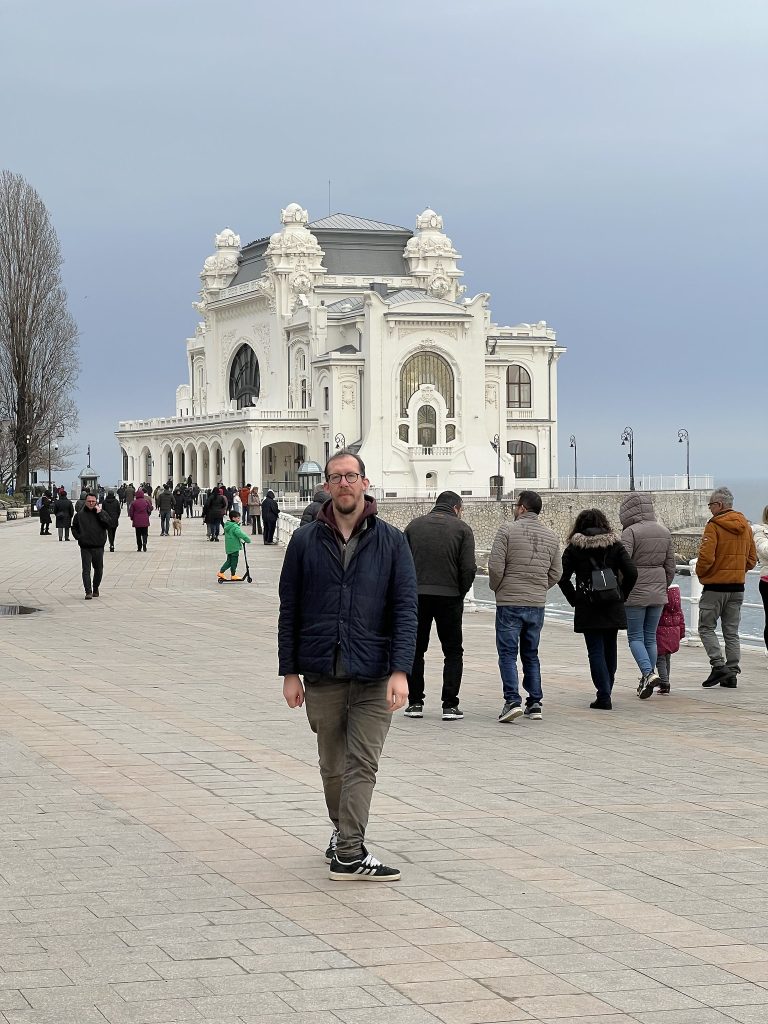
The Edge of the Continent
Walk inland and the rhythm changes instantly.
Old men play backgammon in the shade.
Students carry beach towels and philosophy books.
The call to prayer echoes faintly over espresso machines.
Constanța is not quite the Balkans, not quite Eastern Europe, not quite Mediterranean.
It feels like Europe thinking about Asia.
From the harbor you sense routes — Odessa, Istanbul, Batumi — places connected less by borders than by currents. Ports rarely belong to a single culture; they belong to direction.
This is why the city feels transitional even when you stay still.
Mamaia: The Parallel Universe
North of the city lies Mamaia, Romania’s famous beach strip — sunbeds, clubs, neon nights, and summer playlists repeating across the sand. It is energetic, modern, almost deliberately disconnected from the old town.
Yet the contrast is the point.
Constanța isn’t a resort with history attached.
It’s a historic city temporarily hosting a resort.
Spend the day in Mamaia, then return after dark to the quiet streets around Ovid Square. You will feel like you changed countries without moving.
Why Constanța Stays With You
Many coastal cities try to impress you with beauty.
Constanța does something stranger — it makes you aware of geography.
You feel distance here: to Istanbul, to the steppes, to empires that once defined maps differently. Standing at the water, you don’t imagine crossing the sea for vacation; you imagine crossing it for trade, exile, or migration.
The Black Sea has always been less about holidays and more about routes.
And that is why the city lingers in memory.
Not because it dazzles, but because it suggests.
Maarten’s Note
I like places where Europe becomes uncertain — where the continent stops behaving like a museum and starts behaving like a story still being written. Constanța feels exactly like that: not a destination, but a pause in the narrative between worlds.
Leave a Reply