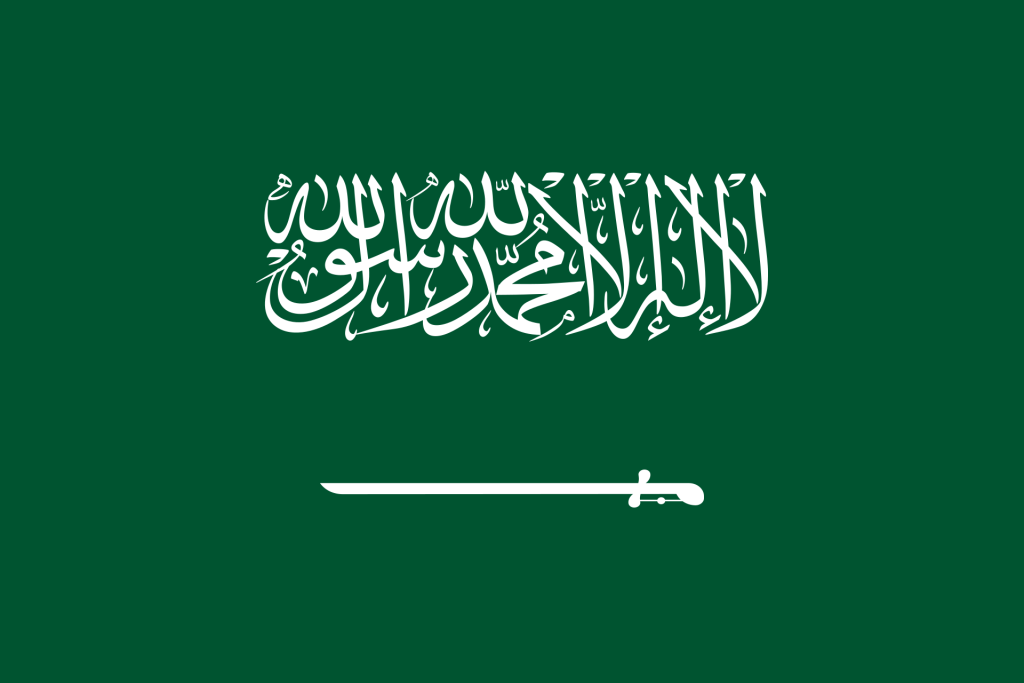
The flag of Saudi Arabia is one of the most distinctive in the world: stark, solemn, and unapologetically religious. Unlike many national flags that balance symbolism with aesthetics or political messaging, the Saudi flag is first and foremost a statement of faith and authority. Its history mirrors the rise of the Saudi state itself — from tribal banners in the deserts of Najd to a unified national emblem recognized across the globe.
Origins: From Najd to the Saudi State
The roots of the Saudi flag lie in the banners used in Central Arabia (Najd) during the 18th and 19th centuries. These early flags were typically plain green or white and carried Islamic inscriptions, reflecting the alliance between the House of Saud (Āl Saʿūd) and the religious reform movement of Muhammad ibn Abd al-Wahhab in the 1740s.
This alliance — often called the Saudi-Wahhabi pact — formed the ideological backbone of the first Saudi state. Banners inscribed with the Shahada (“There is no god but Allah; Muhammad is the Messenger of Allah”) were used in military campaigns and as symbols of political-religious legitimacy. There was no standardized design yet, but the core elements were already present: green, white calligraphy, and Islamic wording.
The 20th Century: Ibn Saud and Standardization
When Abdulaziz ibn Saud (Ibn Saud) began his reconquest of Arabia in 1902 — starting with the capture of Riyadh — he revived and adapted these traditional banners. His early flags varied in design, but most featured:
- A green background
- The Shahada in white
- Sometimes additional inscriptions or decorative elements
As Ibn Saud gradually unified most of the Arabian Peninsula — culminating in the proclamation of the Kingdom of Saudi Arabia in 1932 — the need for a standardized national flag became clearer.
By the 1930s and 1940s, a clearer version of the modern design emerged:
- A solid green field
- The Shahada centered in white
- A sword placed beneath the inscription
However, the position and style of the sword varied in early versions. In some flags, the sword was shorter, angled differently, or placed closer to the text.
The Sword: From Victory to Justice
The inclusion of the sword beneath the Shahada is significant and evolved over time.
Originally, the sword symbolized:
- The military victories of Ibn Saud
- The unification of the Arabian Peninsula
- The power of the Saudi state
Over time, its meaning broadened to represent:
- Justice under Islamic law
- Authority of the state
- Defense of faith and territory
By the mid-20th century, the sword’s design became more standardized: a traditional curved Arabian sword (saif), pointing to the left.
Formal Codification (1973)
In 1973, Saudi Arabia officially codified the design of its flag into law, fixing its proportions and elements. The modern specifications include:
- A rectangular green field
- The Shahada written in a specific stylized Thuluth script
- A single horizontal sword beneath the text
- The sword must be aligned properly with the inscription
The official proportions are approximately 2:3, though slight variations exist in practice.
Why the Flag Is Never at Half-Mast
One of the most unusual aspects of the Saudi flag is that it is never flown at half-mast, even in times of mourning.
The reason is simple but profound: the flag contains the Shahada, the fundamental declaration of Islamic faith. Lowering it would be seen as lowering the word of God — something considered deeply inappropriate.
For the same reason:
- The flag is treated with exceptional respect
- It should not touch the ground
- It is rarely printed on items like clothing, cups, or disposable materials
Design Stability vs. Change
Unlike many national flags that have evolved through revolutions, regime changes, or rebranding, the Saudi flag has been remarkably stable since the mid-20th century.
There have been no major redesigns, only refinements:
- More consistent calligraphy
- Clearer placement of the sword
- Better manufacturing standards
This stability reflects the continuity of Saudi political and religious identity since 1932.
The Flag in a Regional Context
Compared to other Middle Eastern flags, Saudi Arabia’s is unique:
- No Pan-Arab colors (red, white, black, green combination)
- No stars, crescents, or geometric patterns
- Entirely text-based and religious
In that sense, it stands apart from flags like those of Egypt, Iraq, Syria, or the UAE, which are rooted in Arab nationalism rather than explicitly Islamic state ideology.
Conclusion: More Than a Flag
The flag of Saudi Arabia is not just a national symbol — it is a visual manifesto.
It tells the story of:
- A desert-based dynasty that built a modern state
- A political system grounded in a specific interpretation of Islam
- A kingdom that prioritizes religious legitimacy over secular symbolism
Where many flags tell stories of revolutions, republics, or colonial pasts, the Saudi flag speaks in a single, unwavering voice: faith, authority, and unity under God.