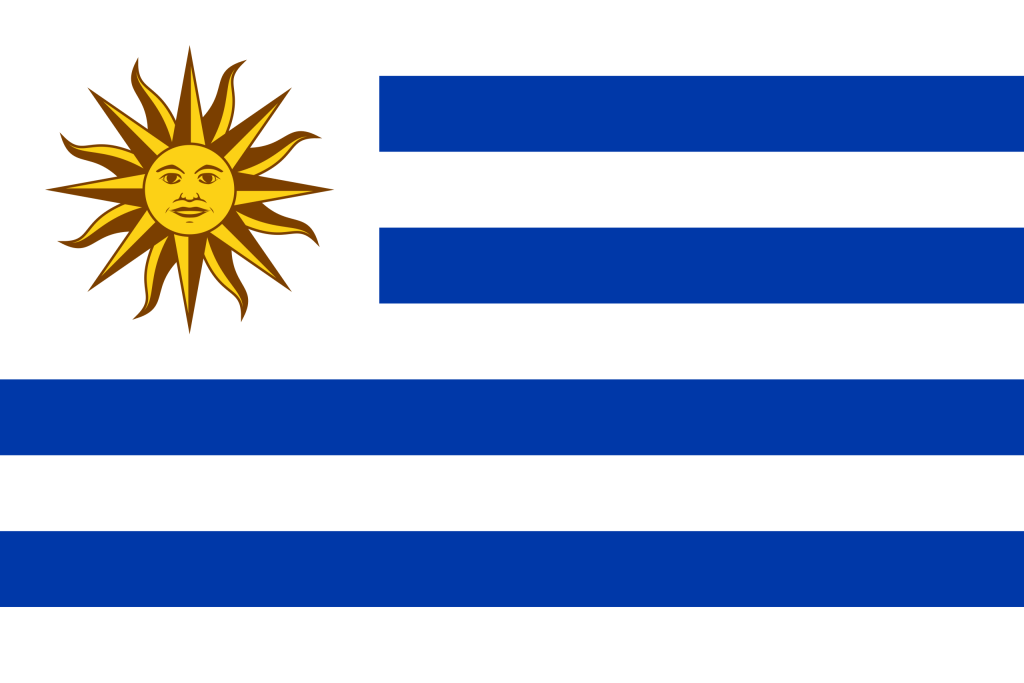
The flag of Uruguay is one of South America’s cleanest and most elegant designs: white and blue horizontal stripes topped by a golden sun with a human face.
At first glance, it may remind some travelers of the flag of the United States because of its striped layout. But Uruguay’s flag tells a very different story — one rooted in independence movements along the Río de la Plata and the emergence of one of Latin America’s smallest yet most stable republics.
The current design was officially adopted on July 11, 1830, only a few years after Uruguay became independent.
The Meaning Behind the Design
The flag consists of:
- nine horizontal stripes,
- a white canton,
- and the famous “Sun of May.”
The Nine Stripes
The stripes represent the original nine departments of Uruguay at the time of independence.
The white and blue colors were inspired by the revolutionary banners used during the independence era in the Río de la Plata region.
The Sun of May
The golden sun in the upper corner is known as the “Sun of May” — one of the most important symbols in South American independence history.
It refers to the May Revolution of 1810, which marked the beginning of independence movements against Spanish rule in the region.
The sun itself is often interpreted as:
- liberty,
- the birth of a new nation,
- and hope after colonial rule.
Its human face gives the symbol a distinctive personality rarely seen on national flags.
Shared Symbolism with Argentina
Uruguay and Argentina share historical and cultural ties, and both countries use the Sun of May on their flags.
This reflects their common origins within the former Viceroyalty of the Río de la Plata and the independence movements that reshaped southern South America in the early 19th century.
Yet Uruguay’s flag feels simpler and more restrained than Argentina’s, reflecting the country’s understated political culture.
A Small Country Between Giants
Uruguay is geographically positioned between two continental heavyweights:
- Brazil,
- and Argentina.
Historically, the country often functioned as a buffer state between competing regional powers.
Despite its relatively small size, Uruguay developed a strong democratic tradition and is frequently viewed as one of Latin America’s most politically stable and socially progressive countries.
The calm symmetry of the flag almost mirrors that reputation.
One of the World’s Most Recognizable Suns
The Sun of May remains one of the most expressive symbols found on any national flag.
Unlike abstract stars or geometric emblems, Uruguay’s sun feels human — almost watchful. Combined with the clean blue-and-white stripes, it creates a flag that feels both formal and optimistic.
It is especially striking when flying against the Atlantic coastline around Montevideo or Punta del Este, where the golden sun seems perfectly matched to the light of the Río de la Plata.
QuixoticGuide Note
Uruguay’s flag does not try to overwhelm. It reflects a country that rarely dominates headlines yet consistently stands apart in South America for its political stability, social openness, and quiet confidence.
The Sun of May gives the design warmth and personality — proof that even minimalist flags can still feel deeply human.