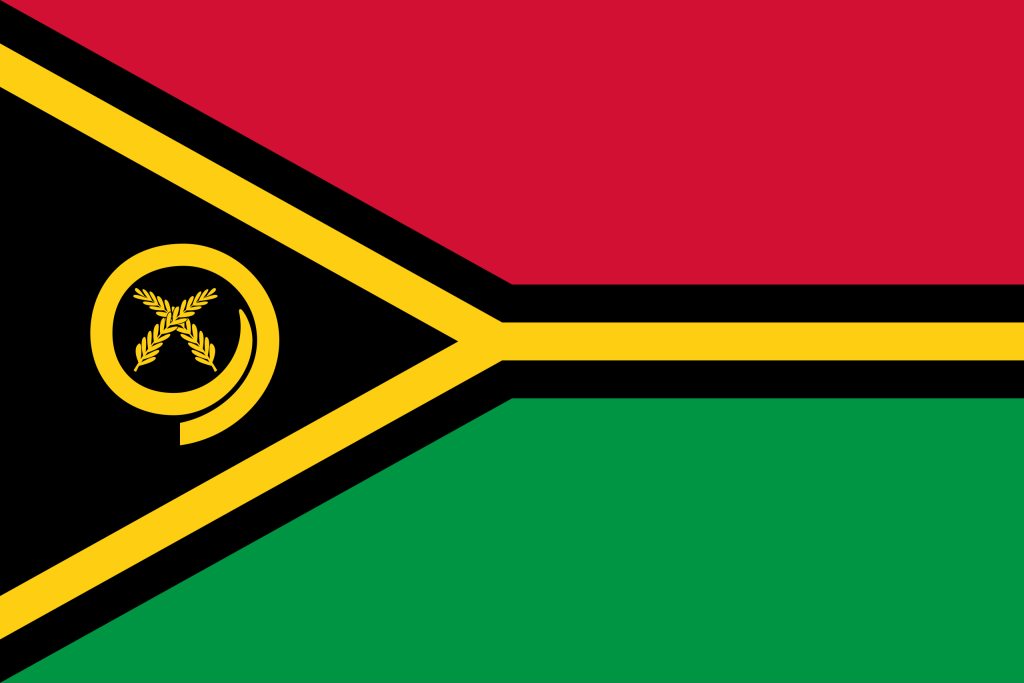
The flag of Vanuatu is one of the most distinctive in the Pacific. Bold, geometric, and deeply symbolic, it combines Pan-African-inspired colors with traditional Melanesian imagery — creating a flag unlike almost any other in Oceania.
Adopted on February 18, 1980, shortly before independence from joint British and French colonial rule, the flag became the emblem of a newly sovereign island nation spread across more than 80 islands in the South Pacific.
A Flag Born from Independence
Before independence, Vanuatu was known as the New Hebrides, a highly unusual colonial territory governed jointly by both Britain and France.
This “condominium” system created one of the strangest administrative arrangements in the colonial world:
- two legal systems,
- two police forces,
- two education systems,
- and two colonial administrations operating simultaneously.
When independence movements gained momentum in the 1970s, Vanuatu sought symbols that reflected both political liberation and indigenous identity.
The result was a flag centered on Melanesian heritage rather than European colonial imagery.
The Meaning Behind the Colors
Red
Represents the blood shed for independence and unity.
Green
Symbolizes the rich vegetation and fertile islands of Vanuatu.
Black
Represents the Melanesian people who form the majority of the population.
Yellow
The yellow Y-shaped stripe symbolizes the light of Christianity and the shape of the islands themselves spreading across the Pacific Ocean.
The Boar’s Tusk and Namele Leaves
5
Inside the black triangle appears one of the most unique symbols found on any national flag:
a boar’s tusk surrounding two crossed namele leaves.
Boar’s Tusk
In traditional Vanuatuan societies, curved pig tusks symbolize prosperity, status, and wealth. Pigs have historically played an important ceremonial role across many Melanesian cultures.
Namele Leaves
The crossed leaves represent peace and traditional authority. In some parts of Vanuatu, namele leaves are used to mark sacred or protected areas.
Together, these symbols connect the modern republic to indigenous customs that long predate colonial rule.
A Pacific Flag Unlike Any Other
Most Pacific island flags feature:
- Union Jacks,
- stars,
- shields,
- or simplified maritime symbolism.
Vanuatu’s flag feels different. It is more angular, more political, and more rooted in indigenous identity.
Its color palette also visually connects it to liberation-era African flags, reflecting broader anti-colonial influences during the late 20th century.
The result is a flag that feels simultaneously Oceanian and revolutionary.
Geography of a Volcanic Nation
Vanuatu lies along the Pacific Ring of Fire and contains multiple active volcanoes, including Mount Yasur — one of the world’s most accessible active volcanoes.
The country is known for:
- volcanic islands,
- dense tropical forests,
- traditional villages,
- and extraordinary linguistic diversity.
Despite having a population of only a few hundred thousand people, Vanuatu is home to more than 100 indigenous languages, making it one of the most linguistically diverse countries on Earth.
QuixoticGuide Note
Vanuatu’s flag feels deeply local. While many post-colonial flags borrowed heavily from European heraldry or generic symbolism, Vanuatu chose imagery tied directly to its own traditions and islands.
The boar’s tusk alone makes it unforgettable — proof that national flags can preserve cultural memory just as much as they project political identity.