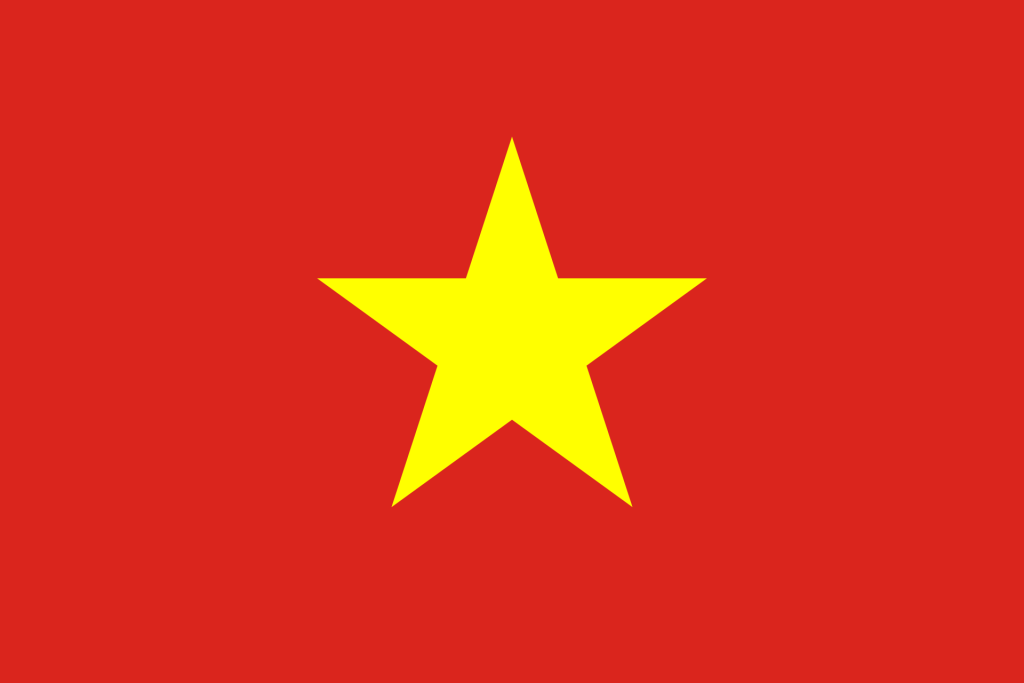
The flag of Vietnam is one of the most recognizable in Asia: a bright yellow star centered on a deep red background. Minimalist yet powerful, the design reflects revolution, independence, and national unity.
Known in Vietnamese as the “Red Flag with Yellow Star,” the flag became the symbol of Vietnamese resistance during the 20th century and later the emblem of a reunified nation.
The current flag was officially adopted for all of Vietnam in 1976, following the reunification of North and South Vietnam after the Vietnam War.
The Meaning Behind the Design
Red Background
The red field symbolizes revolution, struggle, and the sacrifices made during Vietnam’s wars for independence.
Like several socialist states, Vietnam adopted red as the color of revolutionary movements and anti-colonial resistance.
Yellow Star
The five-pointed yellow star represents the unity of the Vietnamese people.
Each point traditionally stands for one of the major groups in society:
- intellectuals,
- farmers,
- workers,
- soldiers,
- and youth.
Yellow also holds historical importance in Vietnamese culture, as it was long associated with imperial dynasties and national identity.
A Flag Born from Resistance
The flag first emerged during anti-colonial resistance against French rule in the 1940s. It became associated with the Viet Minh movement led by Ho Chi Minh.
After the division of Vietnam in 1954:
- North Vietnam used the red flag with the yellow star,
- while South Vietnam used a yellow flag with three red stripes.
Following the fall of Saigon in 1975 and national reunification in 1976, the northern flag became the national flag of the entire country.
Simplicity and Visibility
Vietnam’s flag is remarkably simple:
- one background color,
- one central symbol,
- no text,
- no coat of arms,
- no additional details.
That simplicity gives it enormous visual strength. The design is easy to recognize instantly, whether flying above government buildings in Hanoi or hanging from cafés and homes during national celebrations.
It is also highly visible in urban Vietnam, where red flags line streets during holidays, political anniversaries, and football victories.
More Than Politics
To outsiders, the Vietnamese flag is often viewed mainly through the lens of war and Cold War history. But inside Vietnam, the flag has evolved into a broader symbol of national pride and unity.
Modern Vietnam is a country of rapid economic growth, dense megacities, motorbike-filled streets, ancient temples, rice terraces, coffee culture, and one of Southeast Asia’s most dynamic young populations.
The flag today exists not only as a revolutionary emblem, but also as a symbol of resilience and transformation.
QuixoticGuide Note
Vietnam’s flag is proof that a simple design can carry immense historical weight. Few national flags are so closely tied to anti-colonial struggle, ideological conflict, and national reunification.
Yet when walking through Vietnam today, the flag often feels less connected to ideology than to collective identity — a reminder of how countries continuously reinterpret the symbols they inherit from history.