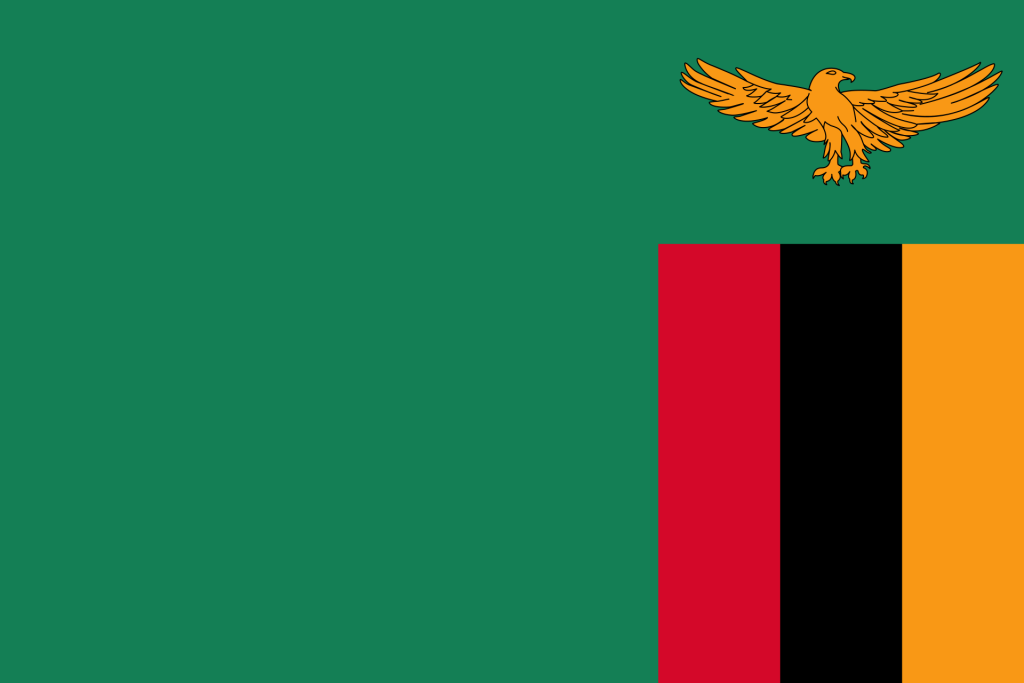
The flag of Zambia is one of Africa’s most distinctive national flags. Unlike many flags that place symbols in the center, Zambia’s design pushes its colors and emblem toward the lower corner — creating a sense of motion and upward movement.
Dominated by green with bold vertical blocks of red, black, and orange, the flag is crowned by a soaring eagle, one of the strongest symbols in southern Africa.
The current flag was adopted on October 24, 1964, the day Zambia gained independence from British colonial rule.
A Flag Designed for a New Nation
Before independence, Zambia was known as Northern Rhodesia, a British protectorate tied economically to mining and colonial administration. As independence movements spread across Africa during the mid-20th century, Zambia emerged as a new republic under President Kenneth Kaunda.
The new flag reflected a break from colonial symbolism and a desire to create a distinctly African identity.
Its design was created by Gabriel Ellison, one of the few women known for designing a national flag in Africa.
The Meaning Behind the Colors
Green
The green background represents Zambia’s natural wealth, vegetation, and fertile landscapes.
From the wetlands of the Bangweulu region to the forests surrounding the Zambezi basin, Zambia is one of the greener countries in southern Africa.
Red
Symbolizes the struggle for freedom and the sacrifices made during the independence movement.
Black
Represents the people of Zambia.
Orange
Stands for the country’s mineral wealth — especially copper, which has long been central to Zambia’s economy and exports.
The Eagle
Above the colored stripes flies the African fish eagle, a bird found across much of sub-Saharan Africa.
On the Zambian flag, the eagle symbolizes:
- freedom,
- resilience,
- and the nation’s ability to rise above challenges.
The positioning matters: the eagle appears to lift upward from the stripes below, visually suggesting progress and ambition.
It is one of the few national flags in the world where an animal appears to be actively moving through the design rather than simply resting within a coat of arms.
A Different Kind of African Flag
Most African flags use horizontal stripes or Pan-African tricolors. Zambia’s flag breaks that pattern.
The asymmetrical layout gives it a modern appearance, while the eagle adds energy and movement rarely seen in national flags. It feels less static than many traditional designs.
The result is a flag that stands out immediately — especially when flying in the wind, where the eagle appears almost airborne.
QuixoticGuide Note
Zambia’s flag feels optimistic. The upward flight of the eagle reflects the atmosphere of the 1960s, when many African countries gained independence and imagined entirely new futures for themselves.
Even decades later, the design still carries that momentum — a visual reminder of a continent redefining itself after colonial rule.