Tokyo moves fast — trains every few minutes, crowds flowing like tides, screens flashing with news from a planet that never pauses.
And yet, right outside Shibuya Station, Japan’s busiest crossing, stands a monument to waiting.
Not efficiency.
Not technology.
Not progress.
Waiting.
The bronze dog at the Hachikō exit is one of the most quietly powerful places in the city. Teenagers arrange first dates here. Friends reunite after years apart. Office workers promise “meet you at Hachi.”
Few monuments in the world are used so casually — and felt so deeply.
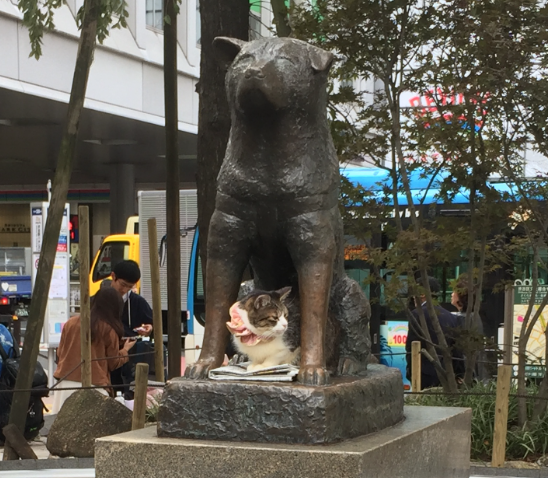
The Story Behind the Statue
In 1923 an Akita puppy was born in northern Japan.
He was adopted by Professor Hidesaburō Ueno, who lived in Tokyo and commuted daily from Shibuya Station.
Every morning, the dog walked him to the train.
Every evening, he returned to wait for his owner’s arrival.
In May 1925, the professor suffered a fatal stroke at work and never came back.
Hachikō still did.
For nearly ten years, every afternoon, he waited at the station entrance for a man who would never step off the train again.
Commuters noticed. Station staff fed him. Newspapers wrote about him.
Tokyo — a city defined by motion — became emotionally attached to an animal defined by loyalty.
When Hachikō died in 1935, the entire country mourned.
A statue was erected while he was still alive. Not after. During.
He attended his own unveiling.
Visiting the Statue
When I visited, I expected a photo stop — another famous landmark to tick off between ramen shops and train lines.
Instead, it felt like a social ritual.
Nobody rushes past Hachikō.
People orbit him.
You see hugs happen here.
Apologies.
Reunions after long trips.
Nervous first meetings.
It functions less like a monument and more like a coordinate system for human connection.
In a city where everything is scheduled to the minute, the most famous meeting place honors the act of waiting without knowing how long.
Why This Story Matters
Modern travel celebrates movement: distances crossed, countries counted, flights logged (and yes — I check the aircraft type before boarding too).
Hachikō celebrates the opposite.
Staying.
The story resonates globally because loyalty is universal, but the setting makes it uniquely Japanese — a culture where devotion, routine, and presence are moral values, not sentimental extras.
The busiest pedestrian crossing on Earth stands beside a memorial to patience.
That contrast is the point.
Maarten’s Note
I’ve visited airports built to eliminate waiting — biometric gates, seamless transfers, transit measured in minutes.
Yet the place that stayed with me most in Tokyo wasn’t the Shinkansen or Haneda’s precision.
It was a dog who missed a train once and then kept coming back forever.
Travel is usually about movement.
But memory attaches to places where someone — or something — chose not to move.
Sometimes a journey becomes meaningful not where you go,
but where someone waited for you to return.
Leave a Reply