In Iraq, there are cities you visit — and cities you enter with reverence. Najaf and Kufa belong firmly to the latter. Arriving here is not just a journey through space, but through time, faith, and moral legacy. At the heart of it all stands one figure: Imam Ali ibn Abi Talib.
Najaf: a city built around a tomb
Najaf feels different from other cities. It seems to breathe around a single focal point: the Shrine of Imam Ali. Its golden dome dominates the skyline, visible from afar, like a moral compass rising from the desert.
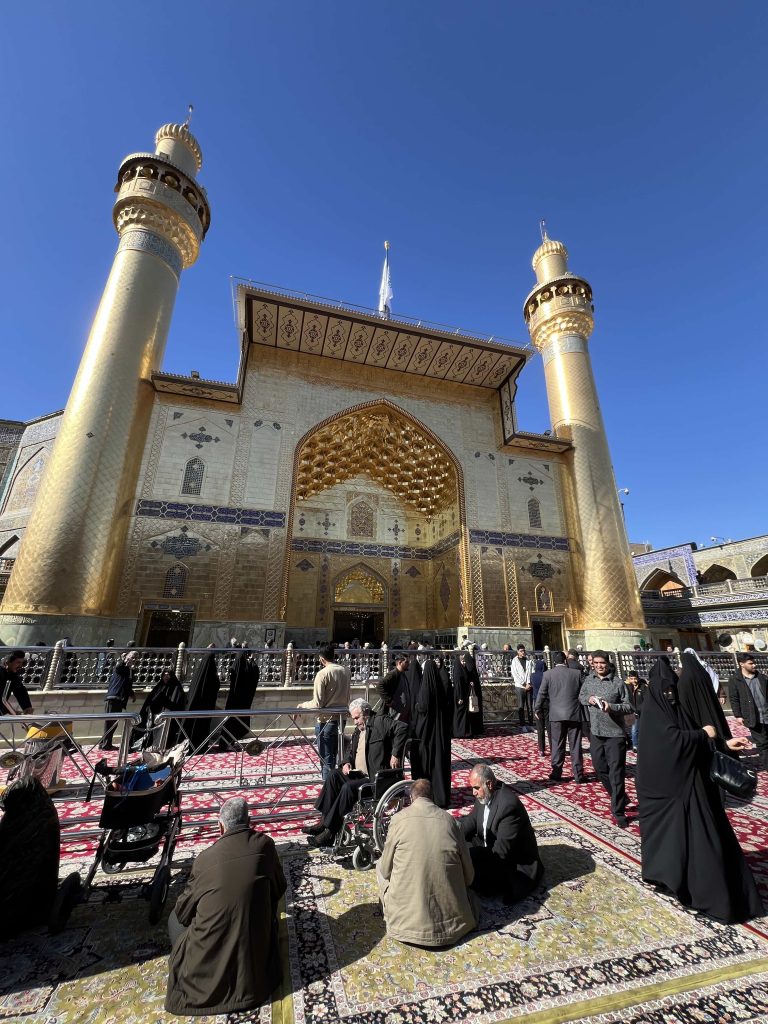
Pilgrims arrive from everywhere: Iran, Pakistan, Afghanistan, the Gulf, and also Europe. Some walk for days. Others arrive quietly, almost unnoticed. Inside the shrine, there is no rush. People sit, pray, whisper, weep. Najaf is not a city of spectacle, but of inner stillness.
That Imam Ali is buried here makes Najaf one of the holiest cities in Shia Islam. Yet even for non-believers, the impact is unmistakable. This is not a museum of the past — it is a living moral centre.
The shadow of knowledge
Beyond pilgrimage, Najaf is also a city of learning. Its renowned hawza (religious seminaries) attract students from across the world. In narrow streets, young men walk with books under their arms, deep in discussion. Knowledge here is not abstract; it is a form of devotion.
Imam Ali was known for his intellect, eloquence, and uncompromising sense of justice. In Najaf, that legacy feels tangible: thinking itself becomes a spiritual act.
Kufa: the city of leadership
Just a few kilometres from Najaf lies Kufa, often overshadowed, yet historically just as significant. It was here that Imam Ali established his capital during his caliphate. In the Great Mosque of Kufa, he governed, delivered justice, and prayed — until he was assassinated here in 661 CE.
Kufa feels more austere, more raw. Fewer pilgrims, more silence. Yet that silence carries weight. This is where ideals collided with power, where justice was tested under immense pressure.
Travelling between two worlds
The short journey between Najaf and Kufa feels deeply symbolic:
from tomb to government,
from memory to action,
from spirituality to politics.
Together, these cities tell the full story of Imam Ali — not only as a saint, but as a human being, a leader, and a moral compass.
Beyond religion
What makes Najaf and Kufa remarkable is that their significance is not purely religious. Imam Ali is respected far beyond the Shia tradition — by Sunnis, Sufis, and even non-Muslims — as a model of ethical leadership.
His words, preserved in Nahj al-Balagha, speak of justice, care for the poor, and the responsibility of those in power — themes that remain urgent in Iraq and far beyond.
A journey that lingers
Visiting Najaf and Kufa is not an easy journey. It is intense, confronting, at times overwhelming. But it offers a rare opportunity to witness how history, faith, and daily life converge.
You do not leave these cities with photographs alone, but with questions — about power, about justice, about how a city, and perhaps a society, can be built around moral principles.
In Najaf and Kufa, one does not merely travel.
One listens.
Leave a Reply