100 Years of NMBS — Belgium’s Quiet Machine of Movement
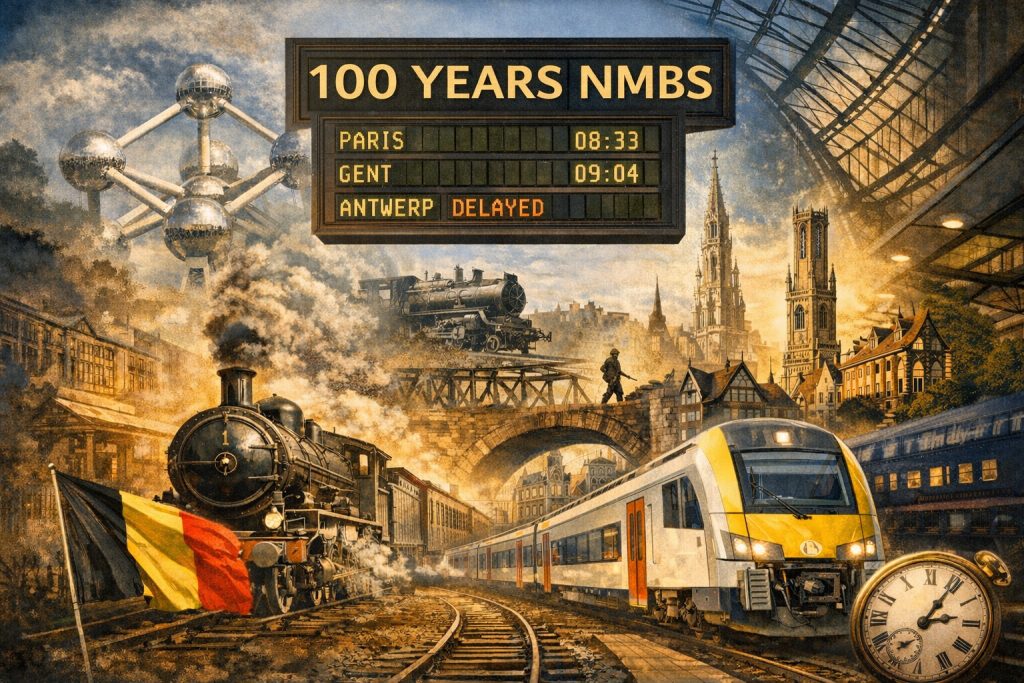
There is a peculiar Belgian habit:
we measure distance not in kilometers, but in minutes.
“Gent is 36 minutes.”
“Antwerp is one delay away.”
“Brussels is… complicated.”
For a century now, that mental geography has been powered by one institution: the NMBS / SNCB — the National Railway Company of Belgium — founded in 1926, but rooted in something older. Because in truth, Belgium did not build railways.
Railways built Belgium.
A Nation Invented Between Stations
Belgium was born industrial and crowded. Ports, coal mines, steel plants, textile towns — all within a day’s travel if the tracks existed.
The railway turned geography into economy.
By the 1930s, trains stitched together a country that spoke multiple languages but shared schedules. Workers crossed provinces daily long before highways existed. The timetable became a neutral national language — more reliable than politics.
Then war came.
Tracks were bombed because they mattered. Bridges collapsed because they connected. After 1945, rebuilding the railway was not infrastructure policy — it was national therapy. When the trains ran again, normal life had permission to return.
The Invention of the Belgian Commute
Post-war electrification quietly changed how Belgians live.
In many countries, people moved to cities.
In Belgium, cities moved to people.
Villages remained villages, yet everyone could work elsewhere. The railway created a uniquely Belgian phenomenon: a dense country without megacities. A dispersed metropolis powered by morning departures and evening arrivals.
Belgium didn’t suburbanize like America.
It synchronized.
The commuter train became the daily parliament — students, lawyers, nurses, civil servants, all temporarily citizens of carriage 5.
The Moment Distance Collapsed
High-speed rail did something strange to Belgium: it shrank the outside world faster than the inside.
Paris became closer than parts of Wallonia.
London became reachable without passports at airports.
Amsterdam became routine.
Belgium stopped being a destination and became a hinge — a place you pass through yet constantly arrive in.
Brussels-Midi turned into Europe’s living room
The Railway Returns to the Future
Today the railway is no longer about speed.
It is about responsibility.
Night trains are back.
Short flights are questioned.
Bikes roll into carriages.
The station becomes the sustainable city gate.
For a century the train adapted to society.
Now society adapts back to the train.
Maarten’s Note
As someone who checks departure boards the way others check weather forecasts, the NMBS feels less like transport and more like atmosphere — the background system that makes Belgian life possible.
Countries often have symbols: flags, monuments, skylines.
Belgium has connections.
Maybe that is why delays provoke national debate:
they interrupt not travel, but the invisible agreement that the country will keep flowing.
After 100 years, the NMBS is not merely a railway company.
It is Belgium’s operating system.
Leave a Reply