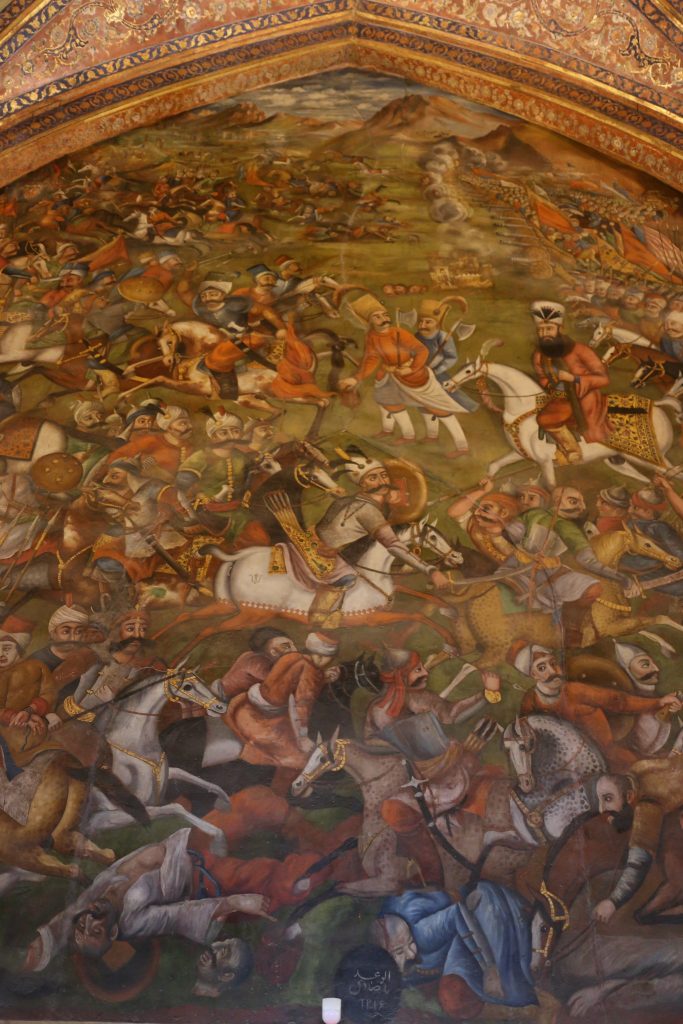
There are places where the wind feels older than the soil.
Chaldiran is one of them.
On 23 August 1514, on a plateau in what is today northwestern Iran near the modern Turkish border, two empires met — and the Middle East tilted.
On one side stood Selim I, the Ottoman sultan: methodical, suspicious, armed with cannon and calculation.
On the other stood Shah Ismail I, poet-king, mystic-warrior, founder of the Safavid state, wrapped in charisma and cavalry.
It was not merely an army against another army.
It was belief against belief.
Certainty against certainty.
The Sound of Modernity
The Ottomans brought artillery.
This matters.
Chaldiran is one of those quiet turning points where technology shifts destiny. The Safavid Qizilbash cavalry — fierce, loyal, ecstatic in their devotion — charged into disciplined lines of Janissaries protected by field guns. The thunder of cannon tore through centuries of steppe warfare tradition.
And just like that, something ancient cracked.
You can almost imagine the moment: the realization that courage was no longer enough.
When Invincibility Breaks
Before Chaldiran, Shah Ismail was more than a ruler. To his followers, he was near-messianic. Victorious, divinely favored.
After Chaldiran, he was human.
The Ottomans briefly captured Tabriz. The Safavid aura dimmed. The psychological wound may have been deeper than the territorial loss.
History often moves not when cities fall — but when myths do.
The Sunni–Shia Geopolitical Legacy: A Deeper Dive
Chaldiran did not create the Sunni–Shia divide. That fracture dates back to the 7th century succession crisis after the Prophet Muhammad’s death.
But Chaldiran weaponized it at an imperial scale.
1️⃣ From Theology to State Identity
Under Shah Ismail, the Safavid Empire made Twelver Shiʿism the official religion of Persia. This was revolutionary. Persia had previously been largely Sunni.
By enforcing Shiʿism institutionally — through clerical structures, education, and state authority — the Safavids transformed a theological tradition into a national-political identity.
The Ottomans, guardians of Sunni orthodoxy and later claimants to the caliphate, defined themselves in opposition.
Chaldiran crystallized this rivalry:
- Ottoman = Sunni imperial center
- Safavid = Shiʿa imperial counterweight
For the first time in centuries, sectarian identity mapped onto geopolitical borders.
2️⃣ The Birth of a Durable Frontier
The Ottoman–Safavid wars continued for more than a century. Eventually, treaties formalized boundaries that resemble today’s Turkey–Iran frontier.
That stability is remarkable.
While empires collapsed and redrew maps elsewhere, this particular divide endured. The cultural fault line between Anatolia and Persia hardened.
It is one of the Middle East’s most stable geopolitical borders — and it was forged in conflict.
3️⃣ The Ripple Effect Across the Region
The Sunni–Shia imperial rivalry radiated outward:
- In Iraq, cities like Najaf and Karbala became Shiʿa sacred centers contested between empires.
- In the Caucasus, populations shifted loyalties and identities under alternating Ottoman and Safavid control.
- In the Arab lands, sectarian alignment often aligned with imperial patronage.
Centuries later, echoes remain visible in regional alignments — from Iraq’s internal dynamics to Iran’s strategic posture in the broader Middle East.
The actors have changed.
The gravitational field has not.
4️⃣ Sectarianism vs. Power Politics
It is tempting to reduce Chaldiran’s legacy to religion alone.
But the deeper truth is more complex.
Sectarian identity became a tool of statecraft. It legitimized expansion, justified repression, and mobilized loyalty. Religion and geopolitics fused.
In many modern conflicts, sectarian language overlays struggles that are fundamentally about power, influence, and security — just as in 1514.
Chaldiran reminds us that belief and strategy often travel together.
A Maarten Note ✍️
When traveling through places where Sunni and Shiʿa histories intersect — whether in Iraq, Lebanon, or beyond — you can feel the layers.
Mosques, shrines, names, narratives.
Chaldiran whispers beneath them.
What fascinates me is not division itself — but endurance. Five centuries later, the Ottoman Empire is gone. The Safavid Empire is gone.
Yet the line they sharpened still shapes regional imagination.
Some battles redraw maps.
Others redraw identities.
Chaldiran did both.
Leave a Reply