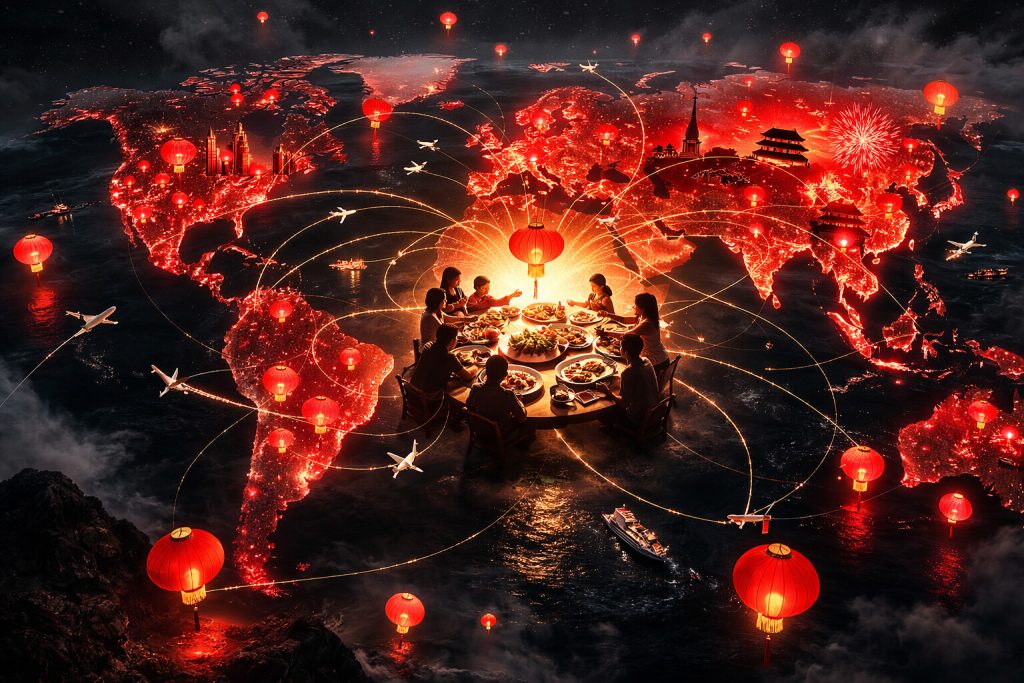
Every year — usually somewhere between late January and mid-February — almost a quarter of humanity presses pause at the same time.
Airports fill. Trains overflow. Cities empty. Villages glow.
Not for war, not for elections, not even for sport —
but for dinner.
Chinese New Year, more accurately the Spring Festival, is the largest annual human migration on Earth. Hundreds of millions travel home in what is called chunyun: a pilgrimage measured not in kilometers, but in belonging.
For one night, geography bends toward family.
Time Measured by the Moon
Unlike the fixed calendar that governs office meetings and airline timetables, the Chinese New Year follows the lunisolar calendar. The date shifts, wandering between winter and the promise of spring — because nature, not bureaucracy, decides when a year truly begins.
Each year belongs to an animal in the zodiac cycle:
Rat, Ox, Tiger, Rabbit, Dragon, Snake, Horse, Goat, Monkey, Rooster, Dog, Pig.
It’s less about superstition than rhythm.
The calendar does not just count time — it characterizes it.
Some years are bold.
Some years cautious.
Some years demand patience.
A Geography of Red
Walk through a Chinatown — in Singapore, San Francisco, Kuala Lumpur, London — and the transformation is unmistakable.
Red lanterns bloom like a second sunset.
Doors acquire calligraphy wishes.
Windows speak prosperity in gold ink.
Red is not decorative. It is defensive.
Tradition says the monster Nian feared loud sounds and bright red — so people answered with fireworks and color.
Today the monster is gone, but the ritual remains.
Civilization often continues long after the danger disappears.
The Rituals of Renewal
Chinese New Year is less a single day than a sequence of symbolic acts:
- Houses are cleaned — sweeping away last year’s misfortune
- Debts are settled — entering the year morally balanced
- Haircuts avoided — you do not “cut” good luck
- Dumplings folded — shaped like ancient silver ingots
- Red envelopes (hongbao) gifted — luck redistributed socially
The festival is a societal reset button.
Western New Year celebrates the future.
Chinese New Year repairs the past.
Fireworks and Memory
Midnight does not arrive quietly.
Firecrackers explode across continents — not only in Beijing, but in Vancouver, Sydney, Paris, Johannesburg. The sound is both celebration and exorcism: noise as purification.
It’s a reminder that holidays are not just dates.
They are technologies for maintaining continuity across generations.
Empires fall. Governments change.
But families still gather around round tables.
The Meal That Anchors the Year
The most important moment is the Reunion Dinner.
Fish — for surplus
Noodles — for longevity
Dumplings — for wealth
Rice cakes — for progress
Nothing is random. Every bite is a metaphor you can taste.
Food here is not cuisine; it is language.
Maarten’s Note
Air travel fascinates me because it compresses space — but Chinese New Year does the opposite. It expands it.
A megacity engineer, a factory worker, a student abroad, a taxi driver in another hemisphere — all orient themselves toward the same table at roughly the same moment.
For one evening, the planet synchronizes emotionally instead of technologically.
We often say globalization connects the world.
But festivals like this show the world was always connected — just waiting for the right date on the moon.
Happy New Year — or as it is said: 新年快乐 (Xīnnián kuàilè).
Leave a Reply