Tirana feels like a city that blinked, stretched, and decided to live loudly.
For decades, Albania’s capital was associated with concrete, isolation, and a heavy communist past. Today, you arrive in a place that seems to have taken that gray memory and painted over it — not to erase it, but to converse with it. Pink, yellow, and mint-green facades line boulevards that once belonged to dictatorship. Street art crawls up old apartment blocks. Espresso cups rattle on café tables late into the night.
Tirana is not polished. It is improvised, energetic, and wonderfully imperfect.
A square that feels like a blank page
Everything begins at Skanderbeg Square — vast, minimalist, almost theatrical in its openness. It feels less like a traditional European plaza and more like a stage where Albania performs its identity.
Stand here long enough and you see the layers collide: Ottoman-era mosque, Italian-era buildings, socialist monumentalism, and contemporary architecture all facing each other, politely disagreeing in stone and concrete. Few capitals wear their contradictions so visibly.
Tirana doesn’t hide its history. It puts it on display.
Inside the bunker, inside the mind
If Tirana has a single essential experience, it is Bunk’Art 2 — a Cold War bunker buried beneath the city center, transformed into a museum of memory.
You descend underground and move through narrow corridors that once prepared for nuclear war. The stories of surveillance, repression, and resistance are told not as distant history, but as lived experience. It is chilling, thoughtful, and deeply necessary.
Tirana is a city that remembers, even as it reinvents itself above ground.
Blloku: from forbidden to free
Nowhere captures this transformation better than Blloku.
Once reserved exclusively for the communist elite, this neighborhood is now Tirana’s beating heart: neon signs, late-night bars, rooftop terraces, and endless macchiatos. Here, Albania’s youth culture pulses — confident, connected, and cosmopolitan.
It is tempting to dismiss Blloku as simply “trendy,” but that misses the point. Its very existence is political: a reclamation of space that was once closed, now radically open.
A capital with mountains on its doorstep
Tirana does not end at its city limits.
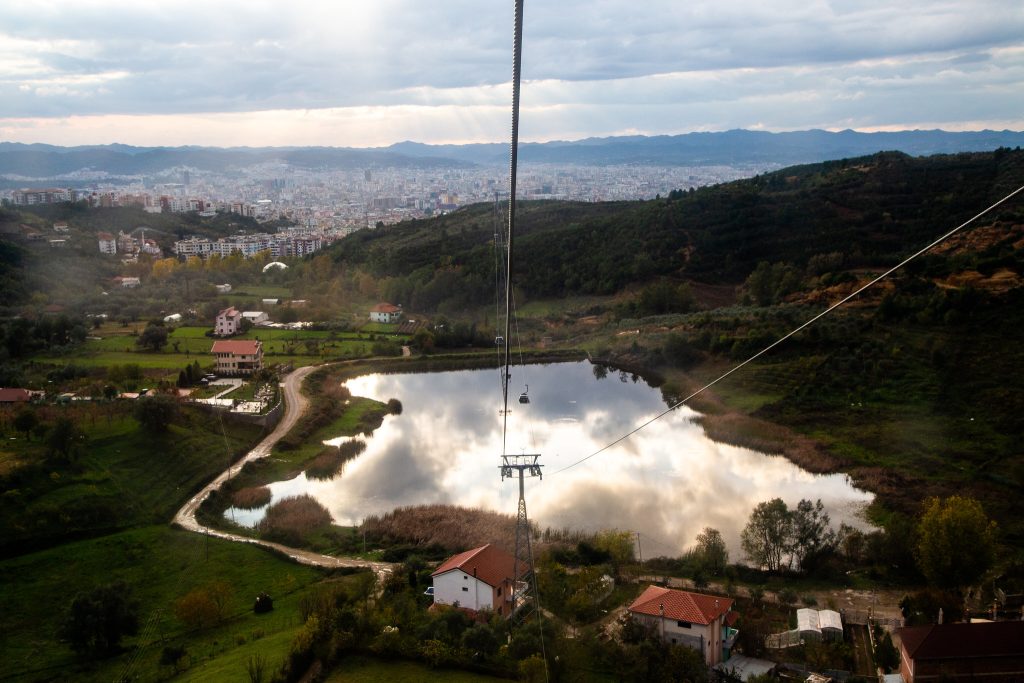
A short ride away, the cable car to Mount Dajti lifts you above the urban sprawl and into pine-scented air. From the summit, Tirana shrinks into a patchwork of colors beneath you — a reminder that this capital is cradled by nature, not swallowed by it.
Looking down, you understand something important: Tirana is still becoming.
Everyday life, served in small cups
Tirana is best understood slowly.
Sit in a tiny café and drink impossibly strong coffee. Wander through Pazari i Ri, where tomatoes, peppers, and herbs spill onto wooden stalls. Try tavë kosi, Albania’s national dish — lamb baked in tangy yogurt — and realize that comfort food can also be history on a plate.
Walk around the lake in the Grand Park at sunset and watch couples, runners, and families drift past. This is a capital that belongs to its people, not just its monuments.
Who is Tirana for?
Not for travelers chasing postcard perfection.
Not for those who want everything neatly packaged.
But for anyone curious about how a society reinvents itself — loudly, creatively, and with stubborn joy.
Tirana is a work in progress. And that is exactly why it matters.
Maarten’s Note
I was in Albania from 13 to 16 November 2019, just as autumn was settling over Tirana. The light had that soft, pale quality that makes concrete look almost tender, and the streets felt quieter than I imagine they do in summer. Those few days made me realize how much Tirana refuses nostalgia: it does not romanticize its past, but it also does not try to erase it. Instead, it builds forward — sometimes messy, often colorful, always defiantly alive. Standing on Mount Dajti and looking down at the city in the late afternoon, I felt as if I was watching a capital still in the act of becoming. That, to me, is far more compelling than any perfectly preserved old town.