On March 1, 1872, something quietly radical happened in the United States.
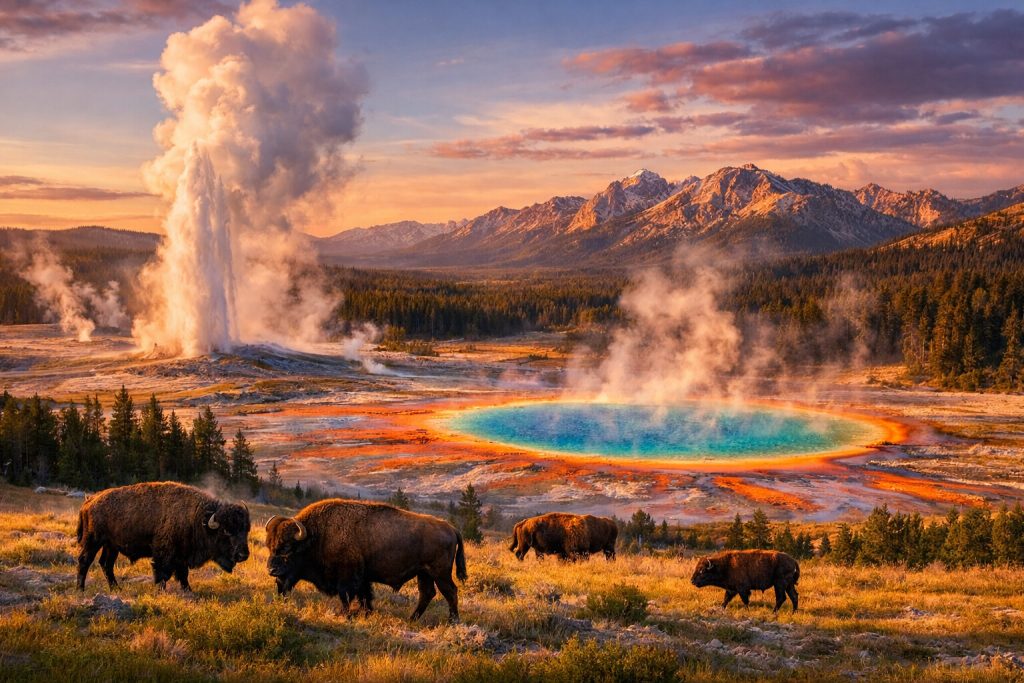
With a signature, President Ulysses S. Grant turned a vast, wild, and geothermally bizarre landscape into Yellowstone National Park — the first national park not just in America, but anywhere in the world. No monument, no private hunting ground, no royal reserve. Instead: land set aside for everyone, forever.
That idea feels obvious now. It was anything but obvious then.
A new idea: land beyond ownership
In the 19th century, land was something to be used, claimed, mined, fenced, logged, or settled. The dominant mindset was expansion — Manifest Destiny — not preservation. Yellowstone disrupted that logic. Instead of asking, “What can we extract from this place?” the question became, “What happens if we simply protect it?”
Explorers like Ferdinand Hayden had documented geysers that shot boiling water into the sky, prismatic pools that looked like something from another planet, and canyons carved by deep time. Some politicians even doubted these reports, assuming they were exaggerations. Yet the more people saw Yellowstone, the harder it became to argue that it should just be another resource frontier.
So Congress did something unprecedented: it declared Yellowstone “a public park or pleasuring-ground for the benefit and enjoyment of the people.”
A precedent that changed the world
Yellowstone didn’t just create a park — it created a model.
Over time, that model spread: Yosemite (1890), Grand Canyon (1919), and eventually hundreds of parks across the United States under the National Park Service. Other countries followed suit, from Banff in Canada to Kruger in South Africa to Torres del Paine in Chile.
What began in a remote corner of Wyoming became a global language of conservation.
Why Yellowstone still matters
More than 150 years later, Yellowstone remains a living laboratory of geology and ecology. Wolves reshaped entire ecosystems after being reintroduced. Bison still roam as they did before the railroads. Beneath it all, a massive supervolcano reminds us that nature is not just scenery — it is powerful, dynamic, and ultimately beyond human control.
Yellowstone is not merely old. It is foundational. It represents the moment humans collectively decided that some places should remain larger than us.
A quiet lesson
Perhaps the most interesting thing about Yellowstone is this: its creation was an act of imagination. Before it existed, there was no category called “national park.” Someone had to invent it.
And once invented, it became impossible to uninvent.
Maarten’s Note
When I think about Yellowstone, I don’t just see geysers and bison — I see an idea traveling. A single decision in 1872 rippled across the world, shaping how we think about landscapes, belonging, and the future.
As a traveler, I’m often drawn to borders, airports, and megacities. Yet Yellowstone reminds me that some of the most powerful human creations are not cities or infrastructure, but concepts: the notion that certain places should exist beyond utility, beyond profit, beyond us.
I wonder what other radical ideas are still waiting to be invented — ideas that might one day feel as obvious as national parks do today.
— Maarten
Leave a Reply